Showing posts with label Astronomy. Show all posts

Thursday, 12 February 2015

big bang

The universe may have existed forever, according to a new model that applies quantum correction terms to complement Einstein's theory of general relativity. The model may also account for dark matter and dark energy, resolving multiple problems at once.
The widely accepted age of the , as estimated by , is 13.8 billion years. In the beginning, everything in existence is thought to have occupied a single infinitely dense point, or . Only after this point began to expand in a "Big Bang" did the universe officially begin.
Although the Big Bang singularity arises directly and unavoidably from the mathematics of general relativity, some scientists see it as problematic because the math can explain only what happened immediately after—not at or before—the singularity.
"The Big Bang singularity is the most serious problem of general relativity because the laws of physics appear to break down there," Ahmed Farag Ali at Benha University and the Zewail City of Science and Technology, both in Egypt, told Phys.org.
Ali and coauthor Saurya Das at the University of Lethbridge in Alberta, Canada, have shown in a paper published in Physics Letters B that the Big Bang singularity can be resolved by their  in which the universe has no beginning and no end.
Old ideas revisited
The physicists emphasize that their quantum correction terms are not applied ad hoc in an attempt to specifically eliminate the Big Bang singularity. Their work is based on ideas by the theoretical physicist David Bohm, who is also known for his contributions to the philosophy of physics. Starting in the 1950s, Bohm explored replacing classical geodesics (the shortest path between two points on a curved surface) with quantum trajectories.
In their paper, Ali and Das applied these Bohmian trajectories to an equation developed in the 1950s by physicist Amal Kumar Raychaudhuri at Presidency University in Kolkata, India. Raychaudhuri was also Das's teacher when he was an undergraduate student of that institution in the '90s.
                                                                                                              source- www.phys.org/          

Saturday, 3 January 2015

ASTEROID GOT A CHANCE


Scientists believe that ABOUT 30 yrs from now an asteroid will hit the earth. They have discovered that it pass us every 3 yrs. The asteroids have an Orbit given below:


            Near Earth Asteroids
Potentially Hazardous Asteroids (PHA) are space rocks larger than approximately 100m that can come closer to Earth than 0.05 AU. None of the known PHAs is on a collision course with our planet, although astronomers are finding NEW ONES all the time.
On January 3, 2015 there were potentially hazardous asteroids.
Recent & Upcoming Earth-asteroid encounters:
Asteroid
Date(UT)
Miss Distance
Size
2014 YC42
Dec 30
4.2 LD
46 m
2014 YE15
Dec 30
2.9 LD
10 m
2014 YD15
Dec 31
1.6 LD
19 m
2014 YE42
Jan 3
4.3 LD
94 m
2014 YP34
Jan 4
8.8 LD
27 m
2007 EJ
Jan 12
68.9 LD
1.1 km
1991 VE
Jan 17
40.6 LD
1.0 km
2004 BL86
Jan 26
3.1 LD
650 m
2008 CQ
Jan 31
4.8 LD
36 m
2000 EE14
Feb 27
72.5 LD
1.6 km

Thursday, 9 October 2014

Mangalyaan: India's race for space success

Mangalyaan: India's race for space success

India rocketThe orbiter lifted off from the Satish Dhawan Space Centre in Sriharikota in November 2013
India's maiden mission to Mars, the Mangalyaan, has arrived in orbit after a 300-day marathon covering over 670 million kilometres (420 million miles). Science writer Pallava Bagla traced its journey as it neared the Red Planet.
On the morning of 24 September, the Indian Space Research Organisation (Isro) slowed down the spacecraft sufficiently so it could be caught in the orbit of Mars.
"India will become the first Asian country to have achieved this and if it happens in the maiden attempt itself, India could become the first country in the world to have reached distant Mars on its own steam in the first attempt," said Isro chairman K Radhakrishnan as it approached.
Both Russia and the US failed in their maiden attempts. The first Chinese mission to Mars, called Yinghuo-1, failed in 2011 alongside the Russian Phobos-Grunt mission with which it was launched. Earlier in 1998, the Japanese mission to Mars ran out of fuel and was lost.
Undoubtedly, India - a late starter - is way ahead of its Asian rivals in trying to get to the Red Planet.
"We are really not racing with anyone, but with ourselves to reach the next level of excellence," said Mr Radhakrishnan.
'Pink of health'
India's Mars Orbiter Mission (MOM) - an indigenously made unmanned robotic mission weighing 1,350kg (2,976lb) - was launched from the rocket port at Sriharikota on the coast of the Bay of Bengal on a balmy afternoon on 5 November last year.
Since then, the mission "has been in the pink of health", says Isro, and has been cruising at breakneck speed to reach close to Mars, half-way around the Sun.
Isro's Mars Mission Control Complex in BangaloreThe health of Mangalyaan is monitored from Isro's Mars mission control complex in Bangalore
The 4.5bn rupee ($74m; £45m) mission is, as Mr Radhakrishnan says, "the cheapest inter-planetary mission ever to be undertaken by the world".
On his visit to India's rocket port on 30 June, Prime Minister Narendra Modi said: "The [making of the] Hollywood movie Gravity cost more than our Mars mission - this is a great achievement."
India's low-cost and quick turnaround satellite mission has been attracting a lot of global attention from the scientific community that seeks to better understand the mysterious Mars.
On the morning of 24 September Indian time, Isro re-oriented Mangalyaan and fired its on-board rocket motor for about 24 minutes to slow the spacecraft.
It was a very tricky operation - if it did not slow down sufficiently, it would have missed being caught by the gravity of Mars and the mission could have be lost in outer space; but if the rocket engine had fired more than required it could have slowed the Mangalyaan so much that it risked crashing down on to the red soil of Mars.
Since 1960, there have been 51 global missions to Mars and the overall success rate stands at 42% so the odds were loaded against the Indian Martian entry.
M Annadurai, head of the Indian Mars mission, said he was "confident that the laws of physics will favour India and the country could have its first robotic Martian baby soon".
'Delusional dream?'
Isro dubs the mission a "technology demonstrator", essentially showcasing to the world that India is no longer a country of snake charmers but a high-tech hub that has developed its technology against the odds and stringent sanctions.
The mission also makes a big global geo-political statement ahead of Mr Modi's imminent visit to the US.
graphic, BBC
In its six-month life, the mission will study the atmosphere of Mars and search for methane gas while asking that eternal question that has dogged humanity: "Are we alone in the universe?"
Within hours of its arrival in the orbit, the spacecraft is expected to relay the first images taken by an Indian eye of the Red Planet and help decipher why and how Mars lost its liquid water.
These are important questions essential for the long-term survival of human beings on Earth.
In the sprint for the Martian marathon, India has shown its technological capability and resilience to undertake arduous inter-planetary journeys.
Many, however, say this bid to reach Mars is a "delusional dream" of India seeking super-power status since 400 million Indians still live without electricity and 600 million people still do not have access to toilets.
However, in real terms, the Mangalyaan has cost India just about four rupees (seven cents; four pence) per person. 
                                                                                              - An Article From BBC

Friday, 3 October 2014

ROCKET LAUNCH FAILURES FROM 1940 TO 2010 VIDEOS

                                               
                                                        A YouTube Video


HELLO! science lovers I am your new updater.

HERE IS AN EXCITING ROCKET LAUNCH FAILURES FROM 1940 TO 2010 VIDEOS

                                                                                      An Article by Shubham Garg

Saturday, 22 February 2014

How Sunspots Form ???


We may all know that sunspots are cooler, so they appear more black than the surroundings. But do we know why they are cooler than other regions? Lets see why they are cooler.

Convective Cells

There are some convective cells or granules on the surface of the sun. They are small areas, where the hot fluid comes up to the surface, loses heat, and then sinks into the surface of the sun just like water when it is being boiled. These cells also contribute to the formation of the sunspots.

Magnetic field of the Sun

You must be knowing how magnetic field lines emerge out of a magnet, like in the picture shown below:


This same thing happens in the sun. And these field lines are formed by the hot plasma that is present inside the sun, not a bar magnet piercing through top and bottom of the sun. As you know that sun moves faster at the center than at the poles, hot plasma at the center also moves faster. So, there is not a straight magnetic field line connecting the north and south pole of the sun. Its like straight from the north pole, then a pointing structure towards the east, then again straight to the south pole. This thing continues so long that the same line takes a whole round of the sun and comes back to touch itself like a snake touching its own tail. This process makes all field lines crowded in a single area. Now, if the part of the field line in the northern hemisphere is having the positive charge, the crowded lines there repel each other due to same charge. They do this by exerting pressure, which is known as magnetic pressure.

Now the convection process (as explained above), plays its role. As heat is transferred to the surface by convection, the fluid coming up pushes the field line above. This pushing causes the field line to poke through the surface from inside, forming a loop and taking all the plasma on the part of the line above, as shown below:


Where they poke through the surface, sunspots are formed there. But why is their temperature down? That's because of magnetic pressure. Now, forget about the poking of the field line through the surface. On the surface of the sun, gas pressure is equally distributed. Now this poking happens. Then, near the area where it poked, there are many more field lines with the same polarity as the field line that is above. So, they repel each other by magnetic pressure. So, near the poked surface, there are two types of pressures - magnetic and gas pressure. So, in these area, the pressure is more than the rest of the surface. So, any how, the pressure must be equally distributed. We can't get rid of the loop until those crowded field lines are given enough time to go away from each other. So, we should lower gas pressure. But how? By inhibiting the convection process. This allows lesser heat than before, so that pressure is equally maintained. So, less heat means less temperature for those areas. So, sunspots are formed.

But they are not that cold. Only 1000 K less than other regions! (5000 K on surface and 4000 K on sunspots).  

Why sunspots are temporary?

Sunspots are of course temporary as when convection is inhibited, the field line slowly comes back inside again. And, those crowded lines also get enough time to repel each other. So, everything comes back to normal.

Now, after studying this, you can make out where sunspots are maximum in number. They will be maximum at the central region as magnetic lines get crowded there more than near the poles. But, sunspots also get formed near the poles, but less in number.

                                                                                                                       Article by - M.Santosh
________________________________________________________________________

Some sources that had been helpful for the making of this article and maybe helpful to you too - 

- http://cse.ssl.berkeley.edu/segwayed/lessons/sunspots/

________________________________________________________________________

Tuesday, 5 November 2013

Mangalyaan - Launch Successful !!!


Mangalyaan Mission, India's first interplanetary mission launched on November 5, 2013 From Sriharikota is launched successfully. 

Mangalyaan will be mapping and studying the surfaces of the red planet Mars.  It is expected to reach into Mars' orbit in the month of September or October 2014. India will have to speed up its process as Mars' moon will be nearest to Earth in 2014 September. For this, India will have to launch in end of 2013 to reach its destination, conserving time and fuel. India is the third Asian Country to attempt Mars Mission, and if it will reach its destination, would become the fourth country to reach Mars.  

                                                                                              - Article By - M. Santosh

Thursday, 31 October 2013

NASA's MAVEN - Mars Atmosphere and Volatile EvolutioN


MAVEN mission graphic


The Mars Atmosphere and Volatile Evolution Mission (MAVEN), set to launch in November 18 2013, will explore the planet’s upper atmosphere, ionosphere and interactions with the sun and solar wind. Scientists will use MAVEN data to determine the role that loss of volatile compounds—such as carbon dioxide, nitrogen dioxide, and water—from the Mars atmosphere to space has played through time, giving insight into the history of Mars atmosphere and climate, liquid water, and planetary habitability. The MAVEN Principal Investigator is Dr. Bruce Jakosky of the University of Colorado’s Laboratory for Atmospheric and Space Physics (CU/LASP), and the project is managed by NASA’s Goddard Space Flight Center.
MAVEN will carry three instrument suites. The Particles and Fields Package, built by the University of California at Berkeley with support from CU/LASP and Goddard Space Flight Center, contains six instruments that will characterize the solar wind and the ionosphere of the planet. The Remote Sensing Package, built by CU/LASP, will determine global characteristics of the upper atmosphere and ionosphere. The Neutral Gas and Ion Mass Spectrometer, provided by Goddard Space Flight Center, will measure the composition and isotopes of neutral ions. Lockheed Martin, based in Littleton, Colorado, will provide the MAVEN spacecraft, as well as mission operations for the mission. NASA’s Jet Propulsion Laboratory will navigate the spacecraft. CU/LASP will provide science operations and data packaging.
                                                                                              - From NASA

Last Preparations for Mangalyaan !!!!!


Mangalyaan Mission, India's first interplanetary mission will be launched on November 5, 2013 From Sriharikota. USA's mission, MAVEN ( Mars Atmosphere and Volatile EvolutioN ) will be launched also in November.

Mangalyaan will be mapping and studying the surfaces of the red planet Mars.  It is expected to reach into Mars' orbit in the month of September or October 2014. India will have to speed up its process as Mars' moon will be nearest to Earth in 2014 September. For this, India will have to launch in end of 2013 to reach its destination, conserving time and fuel. India is the third Asian Country to attempt Mars Mission, and if it will reach its destination, would become the fourth country to reach Mars.  

                                                                                              - Article By - M. Santosh

Tuesday, 22 October 2013

Apocalyptic Comet - Story about 28 million years ago...


Scientists and researchers have found a small stone with diamonds in the Sahara Desert. They think it was the first evidence of a comet strike, and that happened 28 million years ago!

This is the first evidence of a comet strike as all the known comets have burned in the atmosphere. As the discovered stone was filled with diamonds, it didn't burn up and was left behind in the desert.


Scientists and researchers think that it was a huge comet that burned in the atmosphere, killed many living species and heated the earth's surface in that part to 3500 C. Due to this heat in the desert, sand in that part of the desert transformed into glass and Egyptian Kings used that glass to make statues and many other kings.

This discovery is very important as this may reveal where that comet came from, was that actually a planet, or something else. This may also reveal how this solar system and earth was made. These comet particles were also found in the upper atmosphere, which made diamonds, which were not visible to naked eye. 

                                                                                                                    - Article by M. Santosh
________________________________________________________________________


First Evidence Found of a Comet Strike on Earth

From National Geographic - 
Saharan glass and a brooch belonging to King Tut provide the first evidence of a comet directly impacting Earth, a new study claims. The finding may help unlock some of the mysteries surrounding the birth of our solar system.
About 28 million years ago a comet exploded over Egypt, creating a 3600°F (2000°C) blast wave that spread out over the desert below. The fiery shock wave melted the sand, forming copious amounts of yellow silica glass scattered over 2,300 square miles (6,000 square kilometers) of the Sahara.
Polished into the shape of a scarab beetle, a large piece of this glass found its way into a brooch owned by the famed Egyptian boy king Tutankhamen.
"Because there is no sign of an impact crater, it has been a mystery as to what kind of celestial event actually could have caused this debris field, but a small, black stone found lying in the middle of the glass area caught our attention," said study co-author David Block, an astronomer at Wits University in Johannesburg, South Africa.
Saharan Surprise
A tiny slice of the black pebble was put through isotopic analysis, which definitely ruled out that it came from a meteor. Instead, the analysis showed that the pebble possessed the unique chemical signature of a comet, measured in terms of elements such as argon and carbon.
"It was then basically a matter of running the movie backwards in time and predicting what temperatures were needed to create the conditions we find that make up the fragment today," Block says. "So when I saw the result of the analyses, I was completely ecstatic to realize that such a piece of cosmic history has been found for the first time right on our doorstep."
While meteors are known to enter the Earth's atmosphere frequently—one can be seen as a shooting star every 15 minutes or so on any random night—not so with comets.
The implosions of comets in planetary atmospheres are exceedingly rare events—the only other definitive case of a comet hitting a planet was back in 1994 when comet Shoemaker-Levy 9 impacted Jupiter's atmosphere.
Astronomical Odds Inspire Caution
And it's because of this rarity that Earth scientist Andrew Glikson of the Australian National University in Canberra, who was not involved in this study, questions if these yellow glass objects, called tektites, might instead have been created through much more common meteoric events, as seen at many impact sites around the world.
"Why can't the material represent a large tektite formed by heating and melting of sand at the Earth's surface by an asteroid impact, such as, for example, the Australite tektites?" asks Glikson.
While this extraterrestrial glass is considered common around many impact sites,  geologist Gerald Johnson, who was not involved in the study, says that beyond the compelling evidence the team presents in their chemical workup of the black pebble, it's not surprising that the research community may be wary of these results.
"A comet, mostly water, vaporizes in the atmosphere and leaves little for the geologic record, while the 'dirt' incorporated in the comet also is disseminated widely and is unlikely to be found because of impact dispersal, surface weathering, and erosion," said Johnson, a meteor impact researcher at the College of William and Mary in Williamsburg, Virginia.
"Undoubtedly, the Earth has been hit numerous times by comets, but our knowledge of these is lacking because comets leave such a poor record ... so this discovery is amazing."
Solar System Origins
Microscopic dust particles from these icy interlopers have been collected from the upper atmosphere and from Antarctic ice, and have been scooped up by space probes.
But having a chance to study sizable comet material firsthand would be exceptional, and Block and his team believe it can offer a unique chance to study the birth of our solar system.
Cosmic particles called presolar grains formed in the stellar cloud of gas and dust that gave birth to our solar system, and are thought to have remained within comets and meteors.
"My bet is that this little rock will unlock some unique secrets in time to come, specifically because it appears packed with presolar grains," said Block.
The comet study will be published in an upcoming issue of Earth and Planetary Science Letters.

Friday, 11 October 2013

Nobel Prize Physics 2013 - For Higgs and Englert


It is a pleasure to hear that the Nobel Prize 2013 went to the scientists who predicted Higgs Boson and the prediction turned out to be true! A higgs boson like particle was observed in the CERN using the Large Hadron Particle Collider before. After that event, scientists began to study it and observed properties of higgs boson as predicted. So, news became viral about it. If the discovery was true, particle physics will be hundred steps ahead. Higgs Boson is a particle that creates a Higgs field in deep space, and whenever anything interacts with it, gains mass. Only photons are the particles that never react with the Higgs Field. Particles that interact more have more mass. 


The of the discovery of the particle was confirmed on March 2013 and the credits went to Higgs and other five scientists, KibbleGuralnikHagen,EnglertBrout. The discovery of the higgs boson completes the standard model of the Universe and now
scientists can briefly explain how elements gain mass to form matter.
                                                                                                                Article by - M.Santosh________________________________________________________________________

Thursday, 19 September 2013

Kepler's Laws of Planetary Motion


Johannes Kepler was a great astronomer is the 17th century, and he was the first to give true predictions and laws of planets' orbits and their properties. Below, there is a brief description of his laws and explanations, why they do so as they are mentioned:

1st Law:


First law states that when multiple planets are orbiting the sun, the planets' orbits are not circular, but an ellipse. An ellipse is a shape, like an oval, with two foci and the sun is present in one of those foci. If there was only one planet orbiting the sun, the planet's orbit would be exactly circular. But when another planets enters, the gravitational pull of both the planets can affect the orbit of each other. So, the orbits become ellipses, or an oval. For example, when only Earth is orbiting the sun, the orbit of Earth would be exactly circular, so therefore, there will be no such thing called seasons as earth won't go away from sun, or come too close to the sun. But when a massive planet like Jupiter or Saturn start orbiting the sun, the massive planet may pull earth away from the sun, when they are in a straight line, for a period of time. But still, earth would be orbiting the sun. But when earth exits the straight line between the sun and the massive planet, the massive planet stops pulling earth, and sun will be the only source, which pulls earth. So, in this period, the earth would move closer to sun. So, it is clear that earth sometimes comes close to sun, and sometimes goes away from sun, staying in orbit. So, the shape finally, is an oval or an ellipse.

2nd Law:

Second law states that the line joining the earth ans sun covers equal areas in equal intervals of time. This means that:


Consider the above picture. Sun is at position A, and Earth is in position B. After two months, Earth is in position C, and a line is connected from sun to earth. We can see that A, B and C form a sector. Take this sector as Y.
After another two months ( same time period between first two positions ), Earth is at position D. So, another sector is formed by A, C and D. Name this sector as Z.
As there is same time period gap between B,C and C,D ; the areas of sectors Y and Z is equal.


3rd Law:

The square of period of revolution of a planet around the sun is directly proportional to he cube of the average radius of the planet's orbit.


This means that the square of the time, taken by a planet to complete its orbit around the sun is directly proportional to the cube of the average radius of the planet's orbit, as it is not a circle. If only one planet orbited around the sun, we would take the average radius as the actual radius of the orbit. This law is commonly known as law of periods. The farthest point of a planet from the sun is called aphelion and the closest point is called perihelion. 

                                                                                                                         Article by M. Santosh
________________________________________________________________________


Friday, 6 September 2013

Why do Planets orbit elliptical ?


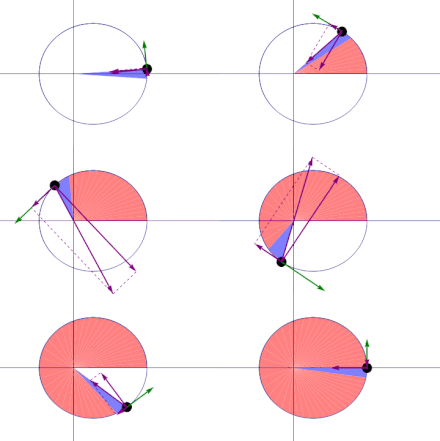
Planets have a tangent velocity, and the sun's gravitational pull pulls Earth towards it. This provides balance, that keeps Earth moving around the sun. When this is clear to you, you will understand why orbits become elliptical.


An Animation from Wikipedia shows how planets
 move away in elliptical orbits

For an Example, imagine a pole fixed to a position, with a rope tied to it. A man starts to hold the rope, and start to move around the pole. When his speed increases, he will not be able to hold the rope tightly, and will fall after a period of time. The same is with planets. When they are close, that means that it is holding to the rope from the sun. When it is moving away, it's grip gets loose, and moves away from the Sun. But when it comes back again to its mean position, it is able to hold on to the rope and therefore, close to the sun. If its speed increases, it will loose the grip of the rope, and escape the orbit. When its speed is little less than the speed to escape the orbit, it moves a little bit away from the sun. Its speed is greatest when near the sun and slow, when away from the sun.

Sometimes, there may be very tiny irregularities of the path of orbit, due to the gravity of other planets like Mars and Jupiter.

                                                                                                        Answer by - M. Santosh
________________________________________________________________________